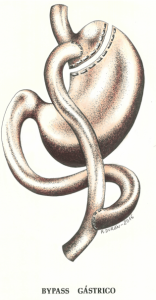
Gastric Bypass is a surgical stomach reduction procedure.
Gastric Bypass reduces gastric capacity and also creates a slight malabsorption of nutrients, resulting in effective and lasting weight loss. It is performed on adult patients (18 to 65 years old) with Type III Obesity (especially with a BMI > 45 kg/m2) or Type II associated with type 2 diabetes mellitus, who have failed to lose weight through diet and exercise. It is the preferred technique for patients with gastroesophageal reflux.
Surgical treatment of Obesity began in 1956 with the introduction of the jejunoileal bypass, which was replaced ten years later by the gastric bypass, due to the severe metabolic complications the former caused. In 2011, it remained the most commonly used surgery for the treatment of Obesity, with a rate of 46.6%, although it is declining due to the increased performance of Sleeve Gastrectomy.
Weight loss is achieved through two mechanisms, combining a stomach with very reduced capacity (restrictive component) along with a bypass in the small intestine that results in only 60% of it being used for nutrient absorption (malabsorptive component). The surgeon creates a small gastric pouch (20-50cc) at the expense of the lesser curvature, along with what is known as a Roux-en-Y loop. The Roux-en-Y loop is formed by sectioning the jejunum about 50 cm from its junction with the duodenum; the distal segment is joined to the gastric pouch (alimentary limb) and the proximal segment (biliopancreatic limb) is sutured 150 cm below the gastrojejunal junction.
The procedure is also performed laparoscopically, with an average duration of 90-150 minutes. If cholelithiasis is present, a cholecystectomy is performed. Subsequently, the patient needs to be hospitalized for about 3-4 days, and can return to normal life in 3-4 weeks.
Gastric Bypass achieves a 60-70% loss of excess weight at 5 years, along with improvement or even remission of comorbidities associated with Obesity, such as hypertension, type 2 diabetes mellitus, dyslipidemia, and sleep apnea syndrome.